12/2/13
Writing advice that helps answer the question....
“You don't take on subject matter because of an objective sense that one sort of subject matter is more important than something else. You take on what you can handle, what you can transform, what you can make your own, what you can make explicable and clear to somebody else, the reader who might stumble across the poem and recognize his or her life in that cloudy mirror.” -- William Matthews
11/11/13
"We Must Risk Delight"
A Brief for the Defense
by Jack GilbertSorrow everywhere. Slaughter everywhere. If babies
are not starving someplace, they are starving
somewhere else. With flies in their nostrils.
But we enjoy our lives because that's what God wants.
Otherwise the mornings before summer dawn would not
be made so fine. The Bengal tiger would not
be fashioned so miraculously well. The poor women
at the fountain are laughing together between
the suffering they have known and the awfulness
in their future, smiling and laughing while somebody
in the village is very sick. There is laughter
every day in the terrible streets of Calcutta,
and the women laugh in the cages of Bombay.
If we deny our happiness, resist our satisfaction,
we lessen the importance of their deprivation.
We must risk delight. We can do without pleasure,
but not delight. Not enjoyment. We must have
the stubbornness to accept our gladness in the ruthless
furnace of this world. To make injustice the only
measure of our attention is to praise the Devil.
If the locomotive of the Lord runs us down,
we should give thanks that the end had magnitude.
We must admit there will be music despite everything.
We stand at the prow again of a small ship
anchored late at night in the tiny port
looking over to the sleeping island: the waterfront
is three shuttered cafés and one naked light burning.
To hear the faint sound of oars in the silence as a rowboat
comes slowly out and then goes back is truly worth
all the years of sorrow that are to come.
8/7/12
I have ventured to paint my happiness on the wall
THE CRAVING FOR SUFFERING -- When I think of the craving to do something, which continually tickles and spurs those millions of young Europeans who cannot endure their boredom and themselves, then I realize that they must have a craving to suffer and to find in their suffering a probable reason for action, for deeds. Neediness is needed! Hence the politicians' clamor, hence many false, fictitious exaggerated "conditions of distress" of all sorts of classes and the blind readiness to believe in them. These young people demand that -- not happiness but unhappiness should approach from the outside and become visible; and their imagination is busy in advance to turn it into a monster so that afterward they can fight a monster. If these people who crave distress felt the strength inside themselves to benefit themselves and to do something for themselves internally, then they would also know how to create for themselves, internally, their very own authentic distress. Then their inventions might be more refined and their satisfactions might sound like good music, while at present they fill the world with their clamor about distress and all too often introduce into it the feeling of distress. They do not know what to do with themselves - and therefore paint the distress of others on the wall; they always need others! And continually other others! - Pardon me, my friend, I have ventured to paint my happiness on the wall.
-- Nietzsche
7/2/12
My father's advice I have never heeded.
“A tree ascended there. Oh pure transcendence!
Oh Orpheus sings! Oh tall tree in the ear!
And all things hushed. Yet even in that silence
a new beginning, beckoning, change appeared.
Creatures of stillness crowded from the bright
unbound forest, out of their lairs and nests;
and it was not from any dullness, not
from fear, that they were so quiet in themselves,
but from just listening. Bellow, roar, shriek
seemed small inside their hearts. And where there had been
at most a makeshift hut to receive the music,
a shelter nailed up out of their darkest longing,
with an entryway that shuddered in the wind --
you built a temple deep inside their hearing.”
-Rilke, Part I, The Sonnets of Orpheus
6/25/12
4/26/12
A Psalm of Life
'Life that shall send A challenge to its end, And when it comes, say, 'Welcome, friend.''
WHAT THE HEART OF THE YOUNG MAN SAID TO THE PSALMIST Tell me not, in mournful numbers,
I
Life is but an empty dream!
For the soul is dead that slumbers,And things are not what they seem.
II Life is real—life is earnest—And the grave is not its goal:
Dust thou art, to dust returnest,Was not spoken of the soul.
III Not enjoyment, and not sorrow,Is our destin'd end or way;
But to act, that each to-morrowFind us farther than to-day.
IV Art is long, and time is fleeting,And our hearts, though stout and brave,
Still, like muffled drums, are beatingFuneral marches to the grave.
V In the world's broad field of battle,In the bivouac of Life,
Be not like dumb, driven cattle!Be a hero in the strife!
VI
Trust no Future, howe'er pleasant!Let the dead Past bury its dead!
Act—act in the glorious Present!Heart within, and ['Verse**] o'er head!
VII
Lives of great men all remind usWe can make our lives sublime,
And, departing, leave behind usFootprints on the sands of time.
VIII
Footprints, that, perhaps another,Sailing o'er life's solemn main,
A forlorn and shipwreck'd brother,Seeing, shall take heart again.
IX
Let us then be up and doing,With a heart for any fate;
Still achieving, still pursuing,Learn to labor and to wait.
3/11/12
The Time Before Death
The Time Before Deathby Kabir (version by Robert Bly)
Friend, hope for the Guest while you are alive.
Jump into experience while you are alive!
Think . . . and think . . . while you are alive.
What you call “salvation” belongs to the time
before death.
If you don’t break your ropes while you’re alive,
do you think
ghosts will do it after?
The idea that the should will rejoin the ecstatic
just because the body is rotten—
that is all fantasy.
What is found now is found then.
If you find nothing now,
you will simply end up with an apartment in the
City of the Death.
If you make love with the divine now, in the next
life you will have the face of satisfied desire
So plunge into the truth, find out who the Teacher is,
Believe in the Great Sound!
Kabir says this: When the Guest is being searched for
it is the intensity of the longing for the Guest that
does all the work.
Look at me, and you will see a slave of that intensity.
11/16/11
I want to be with people who submerge

10/20/11
Give thanks and lie down in peace, Having seen your salvation.

7/14/11
Parable of the Madman

The Parable of the Madman
- Friedrich Wilhelm Nietzsche (October 15, 1844 – August 25, 1900)
Have you not heard of that madman who lit a lantern in the bright morning hours, ran to the market place, and cried incessantly: "I seek God! I seek God!"---As many of those who did not believe in God were standing around just then, he provoked much laughter. Has he got lost? asked one. Did he lose his way like a child? asked another. Or is he hiding? Is he afraid of us? Has he gone on a voyage? emigrated?---Thus they yelled and laughed
The madman jumped into their midst and pierced them with his eyes. "Whither is God?" he cried; "I will tell you. We have killed him---you and I. All of us are his murderers. But how did we do this? How could we drink up the sea? Who gave us the sponge to wipe away the entire horizon? What were we doing when we unchained this earth from its sun? Whither is it moving now? Whither are we moving? Away from all suns? Are we not plunging continually? Backward, sideward, forward, in all directions? Is there still any up or down? Are we not straying, as through an infinite nothing? Do we not feel the breath of empty space? Has it not become colder? Is not night continually closing in on us? Do we not need to light lanterns in the morning? Do we hear nothing as yet of the noise of the gravediggers who are burying God? Do we smell nothing as yet of the divine decomposition? Gods, too, decompose. God is dead. God remains dead. And we have killed him.
"How shall we comfort ourselves, the murderers of all murderers? What was holiest and mightiest of all that the world has yet owned has bled to death under our knives: who will wipe this blood off us? What water is there for us to clean ourselves? What festivals of atonement, what sacred games shall we have to invent? Is not the greatness of this deed too great for us? Must we ourselves not become gods simply to appear worthy of it? There has never been a greater deed; and whoever is born after us---for the sake of this deed he will belong to a higher history than all history hitherto."
Here the madman fell silent and looked again at his listeners; and they, too, were silent and stared at him in astonishment. At last he threw his lantern on the ground, and it broke into pieces and went out. "I have come too early," he said then; "my time is not yet. This tremendous event is still on its way, still wandering; it has not yet reached the ears of men. Lightning and thunder require time; the light of the stars requires time; deeds, though done, still require time to be seen and heard. This deed is still more distant from them than most distant stars---and yet they have done it themselves.
It has been related further that on the same day the madman forced his way into several churches and there struck up his requiem aeternam deo. Led out and called to account, he is said always to have replied nothing but: "What after all are these churches now if they are not the tombs and sepulchers of God?"
6/17/11
that's why they're called nobodies. Failures are unforgettable.

To pay for my father's funeral
I borrowed money from people
he already owed money to.
One called him a nobody.
No, I said, he was a failure.
You can't remember
a nobody's name, that's why
they're called nobodies.
Failures are unforgettable.
The rabbi who read a stock eulogy
about a man who didn't belong to
or believe in anything
was both a failure and a nobody.
He failed to imagine the son
and wife of the dead man
being shamed by each word.
To understand that not
believing in or belonging to
anything demanded a kind
of faith and buoyancy.
An uncle, counting on his fingers
my father's business failures—
a parking lot that raised geese,
a motel that raffled honeymoons,
a bowling alley with roving mariachis—
failed to love and honor his brother,
who showed him how to whistle
under covers, steal apples
with his right or left hand. Indeed,
my father was comical.
His watches pinched, he tripped
on his pant cuffs and snored
loudly in movies, where
his weariness overcame him
finally. He didn't believe in:
savings insurance newspapers
vegetables good or evil human
frailty history or God.
Our family avoided us,
fearing boils. I left town
but failed to get away.
further reading
5/7/11
meeting with the dark side of the moon
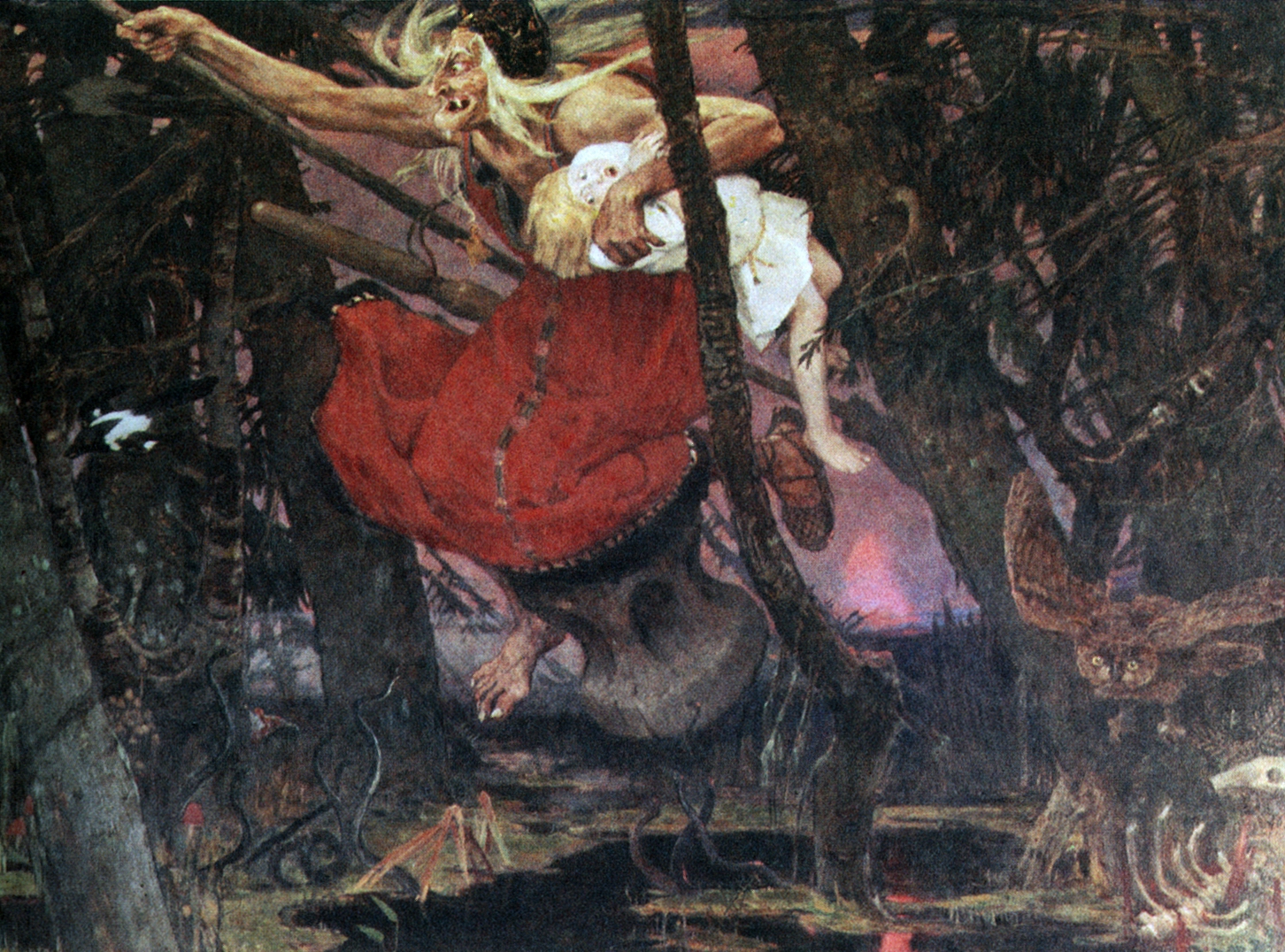
"So we do not descend to the bottom of the hill merely by seeing the dark side of ourself, or our friends, difficult as that is, Baba Yaga, in Russian tales, asks: Are you here to pursue a good deed or to shirk it? We reach the bottom when Baba Yaga's hostile boar energy has completely replaced - for a time - childlike eros which each of us felt when our mother set a breast to our mouth, or later set a cup of milk down for us at the table, or when our first marvelous girlfriend beckoned us to bed. These loves are all well; but descent is complete when both have been replaced by the boar-tusked, hog bristled, big-mouthed, skull-necklaced, insanely high-spirited energy of Baba Yaga.
Something wants us there, wants the meeting with the Dark Queen, wants the boar to open his mouth, wants Grendel's pool to fill with blood, wants the swords to melt, wants the Giantess to put the boy in her sack.
Young men in our culture often imagine, when they look forward to meeting Baba Yaga, that they can "kill" her. They imagine annihilation, total victory; but the stories make clear that such fantasies belong to the uninitiated men. The only solution to power of the witch is for the young man to develop energy as great as hers, as harsh, as wild, as shrewd, as clear in its desire. When a young man arrives at her house, proves himself to be up too her level of intensity, purpose, and respect for the truth, she will sometimes say, "Okay, what do you want to know?" -- Robert Bly from "Iron John"
5/4/11
And the thoughts of men are widen'd with the process of the suns

Saw the Vision of the world, and all the wonder that would be;
Saw the heavens fill with commerce, argosies of magic sails,
Pilots of the purple twilight, dropping down with costly bales;
Till the war-drum throbb'd no longer, and the battle-flags were furl'd
In the Parliament of man, the Federation of the world.
There the common sense of most shall hold a fretful realm in awe,
And the kindly earth shall slumber, lapt in universal law.
...
. . . Yet I doubt not thro' the ages one increasing purpose runs,
And the thoughts of men are widen'd with the process of the suns.
5/3/11
Long live the weeds
5/2/11
the wind left. And I wept. And I said to myself

The Wind, One Brilliant Day
- Antonio Machado
Translated by Robert Bly
The wind, one brilliant day, called
to my soul with an odor of jasmine.
"In return for the odor of my jasmine,
I'd like all the odor of your roses."
"I have no roses; all the flowers
in my garden are dead."
"Well then, I'll take the withered petals
and the yellow leaves and the waters of the fountain."
the wind left. And I wept. And I said to myself:
"What have you done with the garden that was entrusted to you?"